Buyer Guidance
How Do I Know If a Southwest Florida Home Has True Sailboat Access?

By Larissa Locke
Expert Real Estate Advisor · Integrity 🌴 1st 🌴 Group · eXp Realty · FL License #3407292
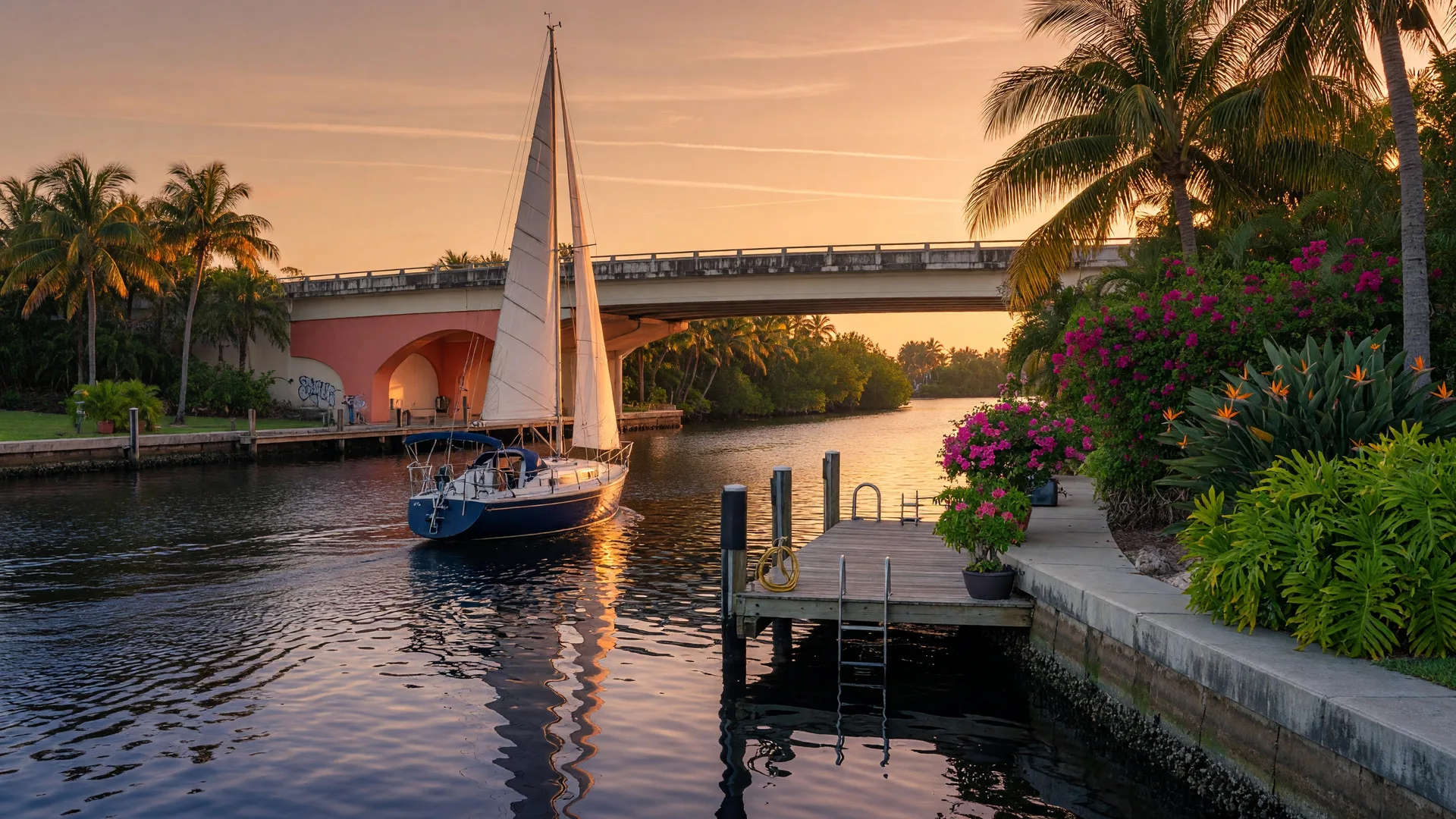
Every week, I talk to boat-owning buyers looking at waterfront properties in Southwest Florida. And every week, at least one of them assumes that because a home is on a canal with water in it, their sailboat can get to the Gulf from that dock. That assumption can cost you a serious lifestyle compromise — or a sale you regret.
True sailboat access is not the same as "waterfront." It is not the same as "boating access." It is a specific, verifiable condition: from your dock to the open waters of the Gulf of Mexico, there cannot be a single fixed bridge that your mast cannot clear. Here is exactly what to check before you buy.
What "Sailboat Access" Actually Means
A property with true sailboat access has an unobstructed navigable water route from your dock to open water — meaning the Gulf of Mexico — with no fixed bridges between you and the Gulf that your mast cannot pass under.
Many homes listed as "waterfront" or "boating access" sit on canals with low fixed bridges that block tall masts entirely. A 40-foot bridge clearance is plenty for a powerboat. For a sailboat with a 55-foot mast, it is a hard stop. The listing agent may not know — and the seller may never have owned a sailboat. The responsibility to verify falls on you.
Bridge Clearance: The Critical Measurement
Bridge clearance is the vertical distance between the water surface and the lowest point of a bridge. Most fixed bridges in Southwest Florida have a clearance between 55 and 65 feet. That works for many cruising sailboats, but not all. Some bridges are under 50 feet — and those are a showstopper for most sailboats with masts over 45 feet.
The key question is not just whether the nearest bridge is high enough. You need to know the lowest bridge on the entire route from your dock to the Gulf. A property near a 60-foot bridge might still be blocked by a 35-foot bridge further down the canal system.
What to ask before you make an offer
- What is the exact clearance (in feet, at mean high water) of every fixed bridge between this dock and the Gulf?
- Are any of those bridges lower than my mast height plus a safety margin of at least 2–3 feet?
- Is there a bascule (drawbridge) option? Some low bridges are movable — but check the opening schedule and whether it is reliable during your typical sailing times.
Draft and Water Depth: Can Your Boat Float Here?
Sailboats typically need 4 to 6 feet of draft — and some keelboats require more. Canals in Southwest Florida can silt up significantly, especially after storms. A canal that was 7 feet deep when the home was built may now be 3.5 feet at low tide.
Check the depth at low tide, not at mean tide. A canal that looks fine at mid-tide may leave you stuck in the mud at low tide — especially in Cape Coral's older canal sections, where silting is a known issue. If you are serious about sailing from your dock, request a depth survey and navigate the route at low tide before committing.
Tides and Currents: The Low-Tide Reality Check
Southwest Florida has significant tidal variation — typically 2 to 4 feet of range depending on location and lunar cycle. Some canals that provide sailboat access at high tide become dangerously shallow or impassable at low tide. This is especially true in Cape Coral's older canal systems, where original dredging depths were shallower and silting has accumulated over decades.
If you plan to sail regularly on your own schedule — not just when the tide is right — you need a canal that holds sufficient depth at low tide for your vessel. Otherwise, your "sailboat access" property is only accessible part of the day.
Seawall and Dock Condition
A property can check every box on paper — no fixed bridges, adequate depth, short run to the Gulf — and still not work for your boat if the seawall and dock are in poor condition. Seawalls in Southwest Florida take a beating from storms, tidal action, and marine growth. A crumbling seawall may need replacement at a cost of $500 to $1,500 per linear foot or more.
Your dock also needs to be long enough and configured correctly for your vessel. A 50-foot sailboat needs a dock that accommodates its length with adequate finger piers or a parallel tie-up. A short, shallow dock designed for a center-console powerboat will not serve your needs.
Seawall inspection checklist
- Is the seawall concrete, vinyl, steel sheet pile, or wood? Each has a different lifespan and maintenance profile in saltwater.
- Are there visible cracks, bulges, or leaning sections?
- Has it been inspected or repaired since the last major storm?
- Does the dock have your required water depth at its outer end at low tide?
- Is there a boat lift or the ability to install one?
Lock Systems: What You Need to Know
In parts of Cape Coral and sections of Fort Myers, the canal system includes locks that control water levels and flow. If your route to the Gulf passes through a lock, you need to understand how it operates.
Questions to ask: What are the lock operating hours? Is there a fee for recreational boat passage? Is the lock sized for sailboats, or is it tight for larger vessels? Does the lock schedule align with your preferred sailing times? Some locks close for maintenance on a regular schedule, and some close during severe weather. A lock-dependent route adds time and complexity to every trip.
Distance to Open Water: Minutes vs. Hours
Two properties in the same city can have vastly different experiences of "sailboat access." One home may have a 10-minute run from dock to open Gulf water. Another may require a 45-minute or longer navigation through canals, rivers, and bays before you see open water. Both are technically sailboat access. They are not the same lifestyle.
Map the full route before you buy. If your idea of sailing is a quick evening cruise after work, a 30-minute run through no-wake canals and winding rivers before you can hoist sails is a limitation you will feel every time. If your trips are weekend or overnight passages, the distance may matter less. Know which type of sailor you are.
Southwest Florida Areas with True Sailboat Access
Cape Coral (sailboat access canal sections). Cape Coral designates certain canals as "sailboat access" canals — these are wider, deeper, and positioned on routes with adequate bridge clearance. They are not all identical. Some run to the Caloosahatchee with favorable clearance; others have restrictions. You need canal-specific verification.
Marco Island. Many Marco Island canals offer excellent sailboat access with relatively short runs to the Gulf through Collier Bay. Bridge heights are generally favorable, and the route to open water is significantly shorter than Cape Coral's longer canal runs.
Naples Bay areas. Homes near Gordon Pass or along navigable channels that lead directly to the inlet can offer some of the best sailboat access in the region — if the route is clear. Depth in Gordon Pass itself can be variable, so verify current conditions.
Portions of Fort Myers Beach and San Carlos Park. Properties in these areas with direct access to the Caloosahatchee or San Carlos Bay can reach the Gulf with bridge clearance that works for most sailing vessels. Route-specific verification is still essential.
Areas with Known Restrictions
Many Bonita Springs canals are connected through the Imperial River and Estero Bay, where bridge clearances and depth restrictions limit sailboat access. Not all Bonita Springs canals can accommodate a mast.
Parts of Estero have canal systems with low fixed bridges or depth constraints that make sailboat access impractical.
Certain Cape Coral sections — especially older neighborhoods with shallow, narrower canals and lower bridge clearances — are designated as powerboat-only or limited-access for sailing vessels. Some advertised "sailboat access" canals may have restrictions at certain bridge points. Always verify the full route.
The rule of thumb
If sailing from your dock is a non-negotiable part of your lifestyle, do not rely on the listing description. Verify every bridge, every depth, and every lock between the property and open water. A 30-minute due diligence call before you buy can save years of frustration after you close.
How Larissa Helps
I work with boat-owning buyers regularly, and I take sailboat access seriously. When a client tells me they need to sail from their dock, I go beyond the listing data. I check bridge clearance specifications — not just for the nearest bridge, but for every bridge on the route. I look up canal depth records and recent storm impacts. I talk to the listing agent and, when needed, the local water management authority.
I also know which canals in Southwest Florida are genuinely sailboat-friendly and which ones are not. That knowledge comes from years of working with boaters — not from a database field in the MLS. If a property is advertised as sailboat access but I know the bridges or depth do not support it, I will tell you before you waste your time.
Buying waterfront in Southwest Florida means buying a lifestyle. If your lifestyle involves sailing, make sure the property actually delivers the access you need.
Buying Waterfront in Southwest Florida?
Make sure your boat can actually get out. Larissa verifies sailboat access — bridge clearances, canal depths, and real-world navigation — before you commit. She knows which canals are sailboat-friendly and which are not.
Successfully,
From Larissa
Larissa Locke is an Expert Real Estate Advisor with Integrity 🌴 1st 🌴 Group at eXp Realty, serving Naples, Bonita Springs, Estero, Fort Myers, and the greater Southwest Florida market. Licensed in 2018, with over 30 years of client-first service spanning healthcare and real estate, she brings a trusted, strategic approach to every transaction. Florida License #3407292.